Middle East Eye | 04/15/2022
maps by Yasemen Cemre Gürbüz
additional reporting by Gabriel Doyle
sponsored by the Pulitzer Center
EMRIYE Uysal, better known as Sugar Auntie, had never expected her cafe to end this way. Laterna Cafe had for ten years been a hive of cigarette smoke, tea and backgammon – a hideout for students on a budget who, if the timing was right, could ask Uysal for a job or a scholarship. It was tucked away on the fringes of Taksim Square, a short sprint from Gezi Park where, in 2013, the same students choked on tear gas during mass anti-gentrification protests and hustled back to the cafe for fresh air and first aid.

Two years later, Uysal found herself arguing with police who emptied the cafe’s furniture into the road. (“What can I do now? I’m 65, but I can work and help these kids,” she begged them.) She couldn’t bear to laugh at the irony: the cafe, a haven from a fast-developing city center, would become a boutique hotel.
A group that defended endangered spots like hers picketed against her eviction, but their message took on a different tone when they realised that the landlord was not an absent speculator, but a 262 year-old Greek hospital foundation. It was claiming its right to evict tenants after a century of discriminatory policy.
“They took good care of us,” said Uysal of the Balikli Greek Hospital Foundation, which also had its hand on the island of shops that separated the cafe from the mouth of the kinetic Istiklal Street. The foundation had kept rents low for years, but when its president died in 2015, the board changed its playbook, taking advantage of new pro-development laws. Though bad news for tenants like Uysal, the foundation insists it’s the only way to survive. “We’re the only Greek foundation running like a business,” said Yani Skarlatos, the general secretary of the new board.

As the saying goes, land in Istanbul is gold. The earliest case of what we now call land speculation began at the close of the nineteenth century. Residents with money scrambled for their chip of the nugget, buying up properties especially along the edge of the peninsula above the Golden Horn.
Back then, the city had 19 million less people, about half of them Muslim and the rest of mixed creeds: Greek Orthodox, Armenian Gregorian, Jewish and various strains of Catholic and Protestant. In the 1920s, the Ottoman Empire dismantled and the Turkish Republic consolidated, triggering the first of many waves of departures of non-Muslims from the city. They donated their apartments to communal foundations – churches, schools, orphanages, hospitals – which used the rent to feed their shrinking budgets.
In the second half of the century, villagers from across the industrializing country crowded into Istanbul, bringing the non-Muslim population down to less than 1 percent of the city. As demand for space rose, the state seized thousands of properties that belonged to these communal foundations, which were well-placed inside Istanbul’s expanding borders.

Istanbul has swelled since Byzantine times, with most megaprojects concentrated in its cultural and commercial center.
These confiscations only stopped in 2008. Turkey was negotiating to join the European Union, which pressured Ankara to protect minority rights. The law it passed would return the properties and regularize the others. But in the decade since, few communal properties have been handed over.
The law’s more visible outcome has been to unlock prime real estate in Istanbul – and to open a fresh front in the contest over who has a right to lay claim to old Istanbul and what its new face will look like.
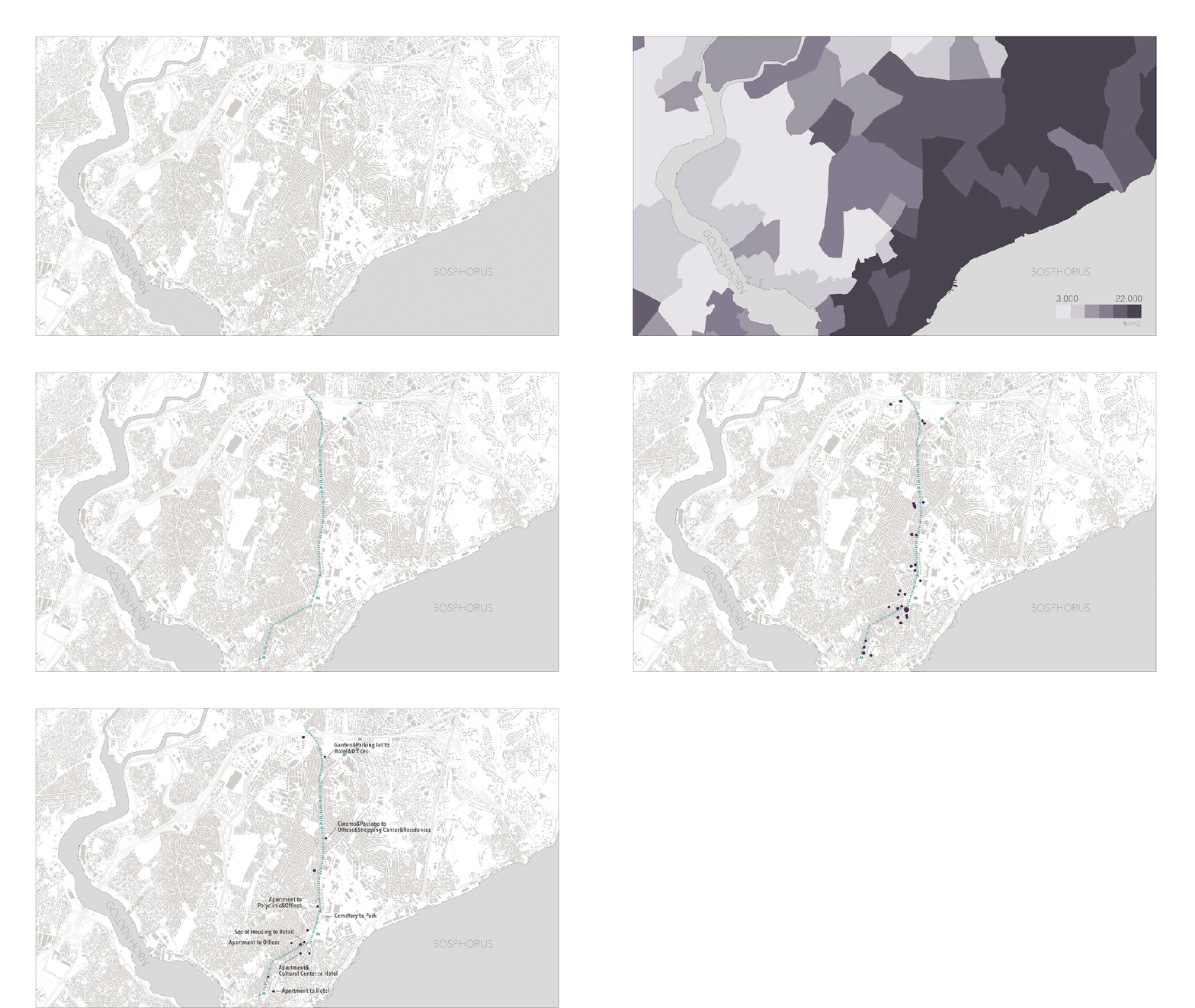
The properties in question are scattered across the city, and many foundations prefer not to disclose their details out of caution. Instead of revealing the full picture, Middle East Eye traces the story of one avenue in Istanbul that has been dramatically altered by this law.
…
 Naomi Cohen | journalist
One thought on “‘Ripping it apart’: How an anti-discrimination law transformed Istanbul”